Friday, June 7, 2013

The adjective “Wagnerian” and more

This week I returned to Santa Cruz from our half-of-the-year home in Hilo.  Consequently, I don’t have the time to write a post on the current topic (Wagner’s anti-Semitism). Hopefully, I am able to get into the swing next week.  For this week I thought I would play with two short subjects:  Wagnerian adjectives and Wagner’s Bacon number (by my rules, he has one).

First, though, I wanted to take the time to thank my partner and greatest supporter, Leslie.  She has patiently listened to me rant for many years, has encouraged me to write this blog, put up with carting all the Wagner papers and books to and from Hilo, works on household stuff while I am writing and, very helpfully, edits my posts.  She is fantastic and I wouldn’t have done it without her.  So thank you so much, sweetie. [Ed. note: you’re welcome!]

Oh, and Leslie takes trippy pictures for the blog.
Also, thanks, Steve, for arranging access to the University of Hawaii, Hilo, library resources.

The Adjective Wagnerian

Merriam-Webster defines Wagnerian as “of, relating to, characteristic, or suggestive of Wagner or his music, stage operas, or theories.”

All the other dictonairies agree with this definition.  But that is just too vague and, essentially, wrong!  Come on, when used as an adjective, we all know it means something along the lines of over the top, massive, loud, grandiose, overwhelming, bombastic or pompous. But while those characteristics can reasonably be laid on his personality (and, arguably, to his notion of the “total work of art”), they really are misplaced regarding his music as I argued here

If I were to write “Wagnerian sensitivity,” most any reader would think that was intended as an ironic statement, meaning the opposite.  Yet any one who listens to Wagner’s music will find it extraordinarily sensitive.  It is, in fact, a vital characteristc of his music, but no one would know that who didn’t listen and only knew his reputation, as shown clearly by the adjective usage associated with him.  It’s a shame, really, but what are you gonna do? Just enjoy the adjectives as they come; please know that they don’t truly refer to the music, but to the man and his plans.

Here are a just a few. Please send in your favorites:

“Wagnerian slabs of sauerbraten,” from The Corrections, page 392.

“Wagnerian toothache,” from Letting Go, page 67.

“…the drama was at the same Wagnerian pitch I was beginning to become accustomed to,” from Portnoy’s Complaint, page 190.

“The two somewhat grotesque Wagnerian figures marched in waddling footsteps,” from Bourne Supremecy, page 659.

“As my bladder chimes in with a Wagner reveille…,” from Positively Fifth Street, page 20.

“Heil Hitler was used as a Wagnerian, pagan-like chant,” from Rise and Fall of the Third Reich, page 8.

“Wagnerian thunder crashed in the background,” from The Moon is Down, page 22.

“White trash developed a runic system of Wagnerian over-statement: monster trucks, nitro-burning funny cars, seven-foot wrestlers…,” from Redneck Manifesto, page 23.

“Wagnerian Smorgasbord,” from The Cheese Plate, page 103.

“The chorus was a massive Wagnerian throng…,” from First in His Class, page 44.

“…a weapon of near-Wagnerian aggression and power,” from A Supposedly Fun Thing I Will Never Do Again, page 231.

“Wagnerian proportions,” from Art Now, page 39.

“Wagnerian heights,” from All Music Guide to Rock, page 8.

“Wagnerian grandiloquence,” in The A List, page 184  (seriously redundant, this one).

“Wagnerian orgasms from the room next door,” from Red Gold, page 85 (I think I want some of these).

“Only relatives, or creditors, ever ring in that Wagnerian manner,” from The Importance of Being Earnest, page 23 (gotta love Oscar Wilde).


Wagner’s Bacon Number

I assume most know what a Bacon number is, but for those who don’t, read about it here

Now, you might wonder how Wagner can possibly have a Bacon number. Well, I had to expand the definition to include operatic productions (including composer or conductor).  In such a cheaty way, Richard Wagner, who died in 1883, has a Bacon number of 4!  This gives me pleasure for some hard-to-fathom reason.

It goes like this:

Wagner wrote operas that his son Siegfried conducted.

Siegfried conducted several Wagner operas that Lauritz Melchoir sang in during 1928.

Lauritz Melchior was in the film The Time for Keeps in 1942 with Kenneth Tobey.

Kenneth Tobey was in Hero at Large in 1980 with Kevin Bacon.

If you have been in a film, it is very hard to not have at least a Bacon number of 3. Hell, I was glimpsed in Gimme Shelter, so I have a 3 (via either Keith Richards, Mick Jagger or, ironically, the Hell’s Angels leader Sonny Barger. If you don’t know why Sonny is ironic, just ask me.) In fact, I will send one dollar to you (via paypal) if you can find an actor or actress that is commonly known who has a 4. Two bucks for a 5.  Three bucks for a 6.  For the game, known” means known to my movie fanatic friend, Harry.  You can only win once, so make it a high dollar one!

To find any actor’s Bacon number, go here.

This concept of the Bacon number is similar to the mathematical Erdös number. A prolific mathematician, Paul Erdös cowrote papers with many folks. Thus, the number relates to degrees of separation between authors of academic papers to him.  If you know anyone in math-related research fields, ask them their Erdös number; they will know it (or it is pretty darn high). 

For Hollywood types who are scholarly, or scientists who are worldly, it is possible to obtain the rare Erdös/Bacon number.  For instance, Colin Firth has an Erdös number of 6, and a Bacon number of 1, so he has the combined number of 7. Natalie Porter has a combined number of 6. Impressive, Natalie!  On the science side, Physicist Richard Feynman has a 3 Erdös and a 3 Bacon, so another 6.  Carl Sagan also has a 6.  So, isn't that fascinating?  

I know this all has very little do with Wagner, but I am indeed tripping, as in this urban dictionary definition: to dwell, or spend excess energy, on a topic or person for an unreasonably long period of time.


Friday, May 31, 2013

Wagner's Anti-Semitism, Part 3: Issues of the mind

This post will focus on the sorts of psychobiological factors that created Wagner’s narrative construction of the Jews as enemies of his cultural and revolutionary program. I am not going to discuss his program or his anti-Semitism in general in this one; this post is foundational for that. Instead, I am just going to focus on brain science in general, and his paranoia and how that fueled his anti-Semitism, in specific. To some readers, you might consider this discussion far afield, but I think in evaluating any person’s character, particularly one who was thought to have mental problems as was the case with Wagner, you need some understanding of brain science. Plus, I believe it is always good to pull back to a bigger and wider picture so that biographical understanding isn’t unnecessarily constricted.

Those who are up on neuroscience know that there is a wide amount of compelling evidence that free will as normally understood doesn’t exist. The neuroscientist Sam Harris, a proponent of this theory, says, “Free will is an illusion. Our wills are simply not of our own making. Thoughts and intentions emerge from background causes of which we are unaware and over which we exert no conscious control.” Sam makes his case in this talk here

In the talk, Sam details the moral issue by way of analogy. Dan Haggard summarizes it in this review: “When we get attacked by an alligator we tend not to get angry at the alligator, but instead we just try to run away. We don’t resent the animal because it’s just an alligator. However, if we are punched by a fellow human being we tend to resent that human. This difference in feeling Harris attributes to the notion of free will that guides us. We think that the animal can’t help do what it does, but we do think the person attacking us can. So, according to Harris, we resent things that we believe to have free will.”

Another neuroscientist David Engleman, doesn’t completely rule out free will, but in this podcast says:
The more we understand about human behavior, the more we understand how people's brains came to be the way they are from a very complicated intertwining of genetic and environment. It turns out if free will exists, it's really a bit player in what is going on in the brain. And the reason is your genes which you don’t choose, and your environment, including your in-utero environment and all your childhood experiences, we don’t choose that. These are the things that come together and make your brain the way it is and define a lot of your trajectory in life. And if you have free will, it can only modulate a lot of momentum and a particular direction.
If you prefer reading, this article by the same author in The Atlantic covers the same ground.

Why this is relevant is that if we accept the proposition that there is no free will, it changes our views of morality and culpability.

To give a taste of the issue—I’m lazily stealing from Mark Linsenmayer’s summary of a Eagleman’s views here—“Eagleman’s point here is that the criminal justice system assumes a model of free will that is unsustainable given what we know about neurology, and he gives examples like a normal guy with no apparent deviant impulses suddenly starts exhibiting child molester behavior. He’s subsequently diagnosed with a giant brain tumor, which is then removed, and his behavior (and self-reported desires) return to normal… but then they return, and what do you know? The tumor’s back.”

But, as Sam Harris argues, “A brain tumor is just a special case of physical events giving rise to thoughts and actions. If we fully understood the neurophysiology of any murderer’s brain, it would be as exculpatory as finding a tumor in it” and, therefore, “the whole conception of placing blame on him would erode.”1

The moral conclusion Harris—a well-know atheist—gives is that the “irony is if you want to be like Jesus and love your enemies, or at least not hate them, one way into that is to view human behavior through the lens of a wider scientific picture of causation.”2 

There are, obviously, people who are well versed in the science on which the view rests, and disagree with this. David Dennett, a philosopher and cognitive scientist, rebuts Sam here. But even he believes that the understanding of an absolute free will in which we are morally culpable for our unfettered “free” choices is incoherent. Dennett argues that we have “practical free will” if not “theoretical free will” and are morally culpable if we are “wired right”—that is free of retardation, brain damage, or mental illness—but our choices are indeed greatly limited by genetics, the environment and brain processes nonetheless.

So even a free will supporter like Dennett believes that diminished capacity greatly reduces or negates free will and such people are, therefore, not culpable for what they do. The question becomes for this blog, if you think free will exists as Dennett argues: did Wagner have diminished capacity—that is, was he mentally ill? Many people have argued just that—both in his time, and to this day. If this is true, can he really be responsible for the bad in his character and actions? Or, for that matter, the good in his works?

I am actually going to take up the subject of his unique brain in more detail at a later point, but I wanted to bring up one of his symptoms now: paranoia.  You can consider this post as the first in my exploration of his mental illnesses or, at least, his mental uniqueness, as well as part of my on-going anti-Semitic posts.

I have a theory, not proven as far as I know in the psychological literature, but certainly true in my life-experience: people with high IQs seem to be more susceptible to paranoia than average folks. What IQ particularly tests is pattern recognition. Therefore, my theory is that those who are able to see deeper, more intricate patterns sometimes go amiss, and create rational and often compelling theories that are, in fact, illusion or delusion. This guy has a similar theory, and has taken the time (unlike me who just googled about a bit...) to find scientific literature to support this theory that paranoia has its roots in a hyperactive pattern matching process, a reinforcement mechanism that rewards high-emotion conclusions, and a hyperactive state of arousal.  Wagner fits into this theory like a glove.

Now, paranoia in schizophrenics is well-established in the literature, as summarized here: “The especially paranoid version of schizophrenia combines hyperactive pattern recognition, specifically for patterns of conspiracy, with other thought disorders, like bizarre ideation (literally bizarre ideas) and ideas of reference (thinking that everything is personal – people and events are referring specifically to them).”  Paranoia, though, sometimes accompanies a wide variety of mental illnesses including depression, bipolar disorder, and obsessive-compulsive disorder.

I have a good friend with schizophrenia—who has a high IQ and two advanced degrees—and what I found is that she is always very rational and very good at narrative construction. Because of this, she managed to convince virtually all of her doctors and friends—including me—of the truth of a particular delusional narrative in spite of the fact that we knew about her disease. Only through a process of fact-checking and communication between everyone were we able to unravel that her narrative was based on paranoid “facts,” and to free ourselves from our participation in her delusion.

Last week's New York Times Magazine had a article called “A Theory of Conspiracy Theories.” The gist: “Perfectly sane minds possess an incredible capacity for developing narratives, and even some of the wildest conspiracy theories can be grounded in rational thinking, which makes them that much more pernicious.”

Before continuing, I do feel it is important to point out that conspiracies do happen. All the time. The tendency to dismiss all conspiracies as paranoia is as irrational as accepting all theories as true. I believe that dismissing all conspiracy theories—as many do out of hand—is wrong and dangerous. If someone raises a serious question as to an event, it deserves a serious answer. I appreciate the work of Skeptic magazine, for example, to do just that (and they adequately debunked the 9/11 truthers theory to me).

Back to the article; it goes on to say that, “more recent scholarship by academics like Mark FensterPeter Knight and Robert Goldberg suggests that conspiracy theories do not come from a particular personality type, I.Q. stratum or dispossessed fringe; they erupt wherever unfathomable news collides with unshakable beliefs.” But none of those cited are scientists, and I couldn’t find any support one way or another in their works for relating IQ to conspiracy theories. I don’t think the work has been done.

In any case, even if conspiracy theories come from anyone on the IQ range, my argument is that more compelling theories will come from people with high IQs because of their more highly developed skills in pattern-recognition and the ability to logically detail the pattern that they perceive.

Whether it is real or delusional can be incredibly hard to figure out.

To wit, my friend David Lifton is a very smart guy, who wrote the NY Times bestseller Best Evidence about the John Kennedy assassination. I do believe in this modern conspiracy theory and I think that David has the best narrative about what happened. He is an indefatigable researcher who has come up with a huge body of persuasive evidence. But, I will add, David is exactly the kind of high intellect, pattern-recognition guy who tends towards paranoia. Therefore, I also recognize that his narrative—consistent, fact-based, logical and compelling as it is—may be utterly wrong. Just like my schizophrenic friend did, he may have pulled me into his world of relentless, but ultimately, delusional logic.


David Lifton no doubt pointing out the location of the head shot that killed Kennedy

This guy wrote a review in Amazon, which hits the nail on the head:

They say truth is stranger than fiction. People often ask whether David Lifton is in touch with reality. Or is he intricately locked in a nightmare from which he never awoke? For my part, this is a genuine soul search. Lifton didn't gravitate in blind fury towards conspiracy. He didn't suspect vast numbers of people of deliberately hiding the truth. Whatever you think of his thesis, "Best Evidence" is saturated in analysis and held together by relentless logic. Suppose, if you will, that Oswald was the sole killer of JFK. In that case Lifton is totally wrong and his book is grotesque fiction. But it remains logical. His logic is just based on a false premise (to use his own language). For me the question is: are any of his crucial premises false? Lifton's conclusion is fantastic. But consider the alternative. For Lifton to be wrong, all the Parkland Hospital doctors and nurses, who originally attended Kennedy, collectively misperceived or falsely described what they saw. Or if they didn't, then all the Bethesda autopsy witnesses did. Lifton doesn't pull this testimony out of thin air. It's on the record. Lifton accounts for all of it in a way few other authors have done. Most critics on the subject rely on discrediting witnesses, usually on a large scale. The same problem applies to defenders of the Warren Report. The point about David Lifton is that he doesn't discredit. He explains. His explanation is outrageous, bizarre and even absurd. Logic can be like that at times.

David actually has much in common with Wagner, so I think he will return later in the blog. Let me just say this:  I do believe—because he has proven it to me—his “outrageous, bizarre and even absurd” narrative of the JFK assassination. If you are a fan of Carrie in Homeland, I suggest David’s work to you. He has the same intensity, focus and drive, though isn’t quite as manic as Carrie was here:


The green pen scene above looked nuts, but we learn that there was rational reason for it, and she had developed her elaborate but true narrative via color-coding. Got to love it.


So glad she got her green pen

A few other example of smart but paranoid successes:


Above is Nobel prize winning John Nash, subject of the film A Beautiful Mind.  He saw both real and delusional patterns. 


Then there is chess genius, Bobby Fisher, one of the great pattern-recognizers of all time. He later descended into a state of paranoia, particularly against the Jews. (He was Jewish).  A psychological assessment is here.


Howard Hughes was another very successful and paranoid guy.   Here is an article on his mental illness.

I could make a lot longer list, of course. Clearly in some humans, paranoia and high intelligence do go together. Each of these well-known folks were paranoid, but all had different types of mental problems.  Nash had classic paranoid schizophrenia, Hughes was OCD, Fisher seemed to just have Paranoid Personality Disorder, Carrie is bipolar (yes, she is fictional, but paranoia can accompany that disease).  The links between high intelligence and mental illness are not fully delineated, though there is a lot of research on the topic.  For instance, see here and here. But most who study the area have concluded that they can be related.  More later when I get to the direct topic of Wagner's mental state.

Now to Wagner and his paranoia. He was the type of guy who constantly created elaborate narratives, sometimes dramatic and fictional, but often in prose and, to his mind, grounded in history. His dramatic narratives are often an ingenious reworking of his source material to construct a compelling original narrative; he had a talent for this. His prose, though, could be really out there, with flights of fancy in which, for instance, he would write as if the mythical gods were interacting directly with historical characters. An example given by the the Wagner scholar, John Deathridge: “The essay the Wibelungen...describes, among other things, a supposed relationship between a historical figure, Friedrich Barbarossa, and a mythical one, Siegfried.”3

As for Wagner’s paranoia, Bryan Magee writes,
We have much evidence from people who knew him well that he was always inclined to think that something must be going on behind his back, that other people were up to something; and his friends took pains not to aggravate this. For instance, during the period when Nietzsche was close to Wagner he wrote a friend about some step he had decided not to take: “We both know that Wagner’s nature tends to make him suspicious, but I did not think that it would be a good thing to stir up his suspiciousness.4 
All his biographers trace Wagner’s eruption of anti-Semitism to his time in France when he groveled and near-starved in an unsuccessful attempt to launch his operatic career. In Paris, he sought assistance from the the most successful opera composer of his time, Giacomo Meyerbeer, who was Jewish. To Meyerbeer’s credit, he did help Wagner in a number of small ways. The story of Wagner’s relationship with Meyerbeer has been told well elsewhere, so I am going to cut to the chase: he became paranoid about Meyerbeer and concluded that he was scheming against him and, thus, Wagner wanted to both publicly cut himself off from any association with him and get revenge for this, alleged, backbiting. Wagner's Judaism in Music was written with this as his primary motivation, according to most historians. For instance, Katz concludes: “Thus his attack on Judaism appeared as the actual goal of the article and the unnamed Meyerbeer only as an example. In reality, it was the reverse”5 

Though the the piece was published anonymously (in 1850), Wagner didn’t otherwise hide his authorship and he was sure that Meyerbeer and other prominent Jews in the music world knew he was the writer. Wagner then became convinced that any bad press he ever received was the result of Jewish machinations against him because of that article. There is no evidence of this at all. When he republished the essay under his own name in 1869, his reason for republication was to expose this alleged conspiracy. Well, the result was that a segment of the Jewish population did, finally, rise up to criticize him in an organized fashion. After two decades, he finally had got the conspiracy he long imagined!


There is no doubt Wagner truly thought that there was a conspiracy, led by Jewish publishers, writers and composers, against him. Nobody doubts he had this strong belief. But there is no evidence it was true. I would argue that these thoughts, strongly held but seemingly delusional, were beyond his conscious control. It was this paranoia that was the launching-pad of his anti-Semitism expression.

Do I conclude, given what I have said about limitation on free will and his incapacitation by way of paranoid delusions, that Wagner should be fully exonerated from responsibility for any of his behaviors? No, as I have quite a few puzzle pieces to add. But I do think what I have laid out in this post, like the reality of the illiberal society I explored in this post, should be taken into considerations in solving the conundrum of Wagner.  


End Notes

1 This comes 18 minutes in the talk.  The implications for legal culpability are addressed here.  
2 This quote comes at 53 minutes in.
3 Deathridge, Wagner Beyond Good and Evil, page 12, emphasis in original letter
4 Magee, The Tristan Chord, page 344.
5 Katz, The Darker Side of Genius, page 51.  This book gives a full account of Meyerbeer and Wagner's relationship.  Also, The Tristan Chord does as well in the Anti-Semitism chapter.

Friday, May 24, 2013

Wagner's Anti-Semitism, part 2: Historical Perspective

I wrote on Facebook on Wednesday (Wagner’s 200th bicentennial) that this post was going to be a rant, but I sort-of unranted it. I’m not good at rants on paper, I guess. But I have dispensed with (most) footnotes for this one (such a wild step for me.) And there remain a couple of obscenities!

I think too much is made of the fact that Wagner was anti-Semitic, particularly given the times he lived in. When I say too much, I don’t mean it shouldn’t be addressed. Of course it should, and I have spent four posts on it, and plan to do several more. What I am talking about is the ludicrous over-reach of modern Wagner scholars. As a topic, it was barely addressed—and this was not a great state of affairs, either—until recent times. But now the floodgates are open, and muddy, foul waters are flowing. For instance, in the 2008 Cambridge Guide to Wagner—which should be a balanced look at his life and works—is inundated with the issue because, as the editor Tom Grey writes in the introduction, “of the indisputable prominence of the topic in Wagner studies and public discussion over the past fifteen or twenty years.” Michael Tanner, a Wagnerian writer who shares my opinion that the subject is both over-pushed and ludicrously analyzed, points out that in this book: “The issue is raised more often than any other single topic. While several chapters are devoted to it and to Wagner’s relationship to the Third Reich, there are six pages devoted to The Flying Dutchman, Tannhäuser and Lohengrin combined.”  This is just out of whack.

Yes, he was anti-Semitic, but so was most of Europe for 2,000 years. As well, most Europeans and Americans who endorsed enlightenment ideals—as Wagner did—didn’t extend those past a sub-group of men. I do, indeed, love and honor those truly enlightened people in the 1800s who actually believed, deeply, in equality for all human beings. But they were a very small minority. Try to come up with some names; it’s very hard. (Leslie suggested Mark Twain, and he certainly was far better than most, but, then, read this regarding the Jews and his essay Concerning the Jews. The fact that Twain is quoted approvingly in neo-Nazi publications shows that even the most liberal of men's words can be twisted.)

Wagner wrote his infamous essay Judaism in Music in 1850. First, let me give you a few out-of-context quotes from it, so you understand the worst sorts of things he said in this essay:

We have to explain to ourselves the involuntary repellence possessed for us by the nature and personality of the Jews, so as to vindicate that instinctive dislike which we plainly recognize as stronger and more overpowering than our conscious zeal to rid ourselves thereof.… The Jew—who, as everyone knows, has a God all to himself—in ordinary life strikes us primarily by his outward appearance, which, no matter to what European nationality we belong, has something disagreeably foreign to that nationality: instinctively we wish to have nothing in common with a man who looks like that....In particular does the purely physical aspect of the Jewish mode of speech repel us. Throughout an intercourse of two millennia with European nations, culture has not succeeded in breaking the remarkable stubbornness of the Jewish nature as regards the peculiarities of Semitic pronunciation. The first thing that strikes our ear as quite outlandish and unpleasant, in the Jew's speech, is a creaking, squeaking, buzzing snuffle: add thereto an employment of words in a sense quite foreign to our nation's tongue, and an arbitrary twisting of the structure of our phrases—and this mode of speaking acquires at once the character of an intolerably jumbled blabber; so that when we hear this Jewish talk, our attention dwells involuntarily on its repulsive how, rather than on any meaning of its intrinsic what.

Clearly, as I have mentioned previously, he found Jews repellent. Certainly, that quote seems mean-spirited and really weird, too. I don’t get it on any level and am glad I don’t. However, as implied by Wagner by using the “we” and as confirmed by many scholars of anti-semitism, these were common views of Jews at that time, and many Jews shared these views about themselves in whole or part. It wasn’t an enlightened time, to say the least. Thankfully—and it certainly means that we have advanced in some good ways—we read that and think: What the fuck? So, Wagner’s publication of this was bad. No doubt at all about that.

But now I want to take a quick survey of the times, mid 19th century, when he wrote the piece. I am concentrating on America, because this blog is focused on an American audience, and this is the history I know intimately. If you are American, you know all this stuff. Skim.

In the United States, slavery was legal. Slaves were the property of slaveholders and could be whipped, raped, and even murdered with legal impunity. Obviously, too, nasty things were said about them as a race. Certainly nastier than what Wagner said about the Jews. There was, of course, an anti-slavery movement but the Great Emancipator himself said, “There is a natural disgust in the minds of nearly all white people to the idea of indiscriminate amalgamation of the white and black races.” This was said in 1857. In the same year, our Supreme Court confirmed, via the Dred Scott decision, that blacks were not citizens, even freemen. In 1896, the utter racism of America was confirmed in the Plessy v. Ferguson decision. As we all know, very bad things continued to be said and done to black people well into the 20th century, and are still being done to this day. (As an aside, Wagner was very anti-slavery.)

Turning to our Native Americans, the 19th century saw the utter decimation of the Indian Nation. The Indian-loathing President Jackson oversaw the expulsion of most tribes from the East via the “Trail of Tears” in the 1830s. Here is part of Jackson's address to Congress in 1833 on the subject of Native Americans:

They have neither the intelligence, the industry, the moral habits, nor the desire of improvement which are essential to any favorable change in their condition. Established in the midst of another and a superior race, and without appreciating the causes of their inferiority or seeking to control them, they must necessarily yield to the force of circumstances and ere long disappear.

Commonly, they were called, and thought to be, savages.  The enmity to Indians didn’t end there, of course. Here's a Wikipedia quote: “After the Civil War, all of the Indians were assigned to reservations; the role of the army was to keep them there.”  In 1869, General Sheridan, in charge of keeping Indians in their place, gave voice to the feelings of many: "The only good Indians I ever saw were dead.” 

Meanwhile, in Europe, pretty much everybody believed that they were superior to non-white cultures, a huge percentage of which had been colonized and the people subjugated to European rule. There was no move away from this trend in the 19th century. It was extremely commonplace to assume that people from Europe were more civilized, superior in all ways, and better looking to boot—particularly when compared to Jews and blacks. In the latter part of the century, this belief was “proven” via pseudo-scientific papers and books.

And of course, there are women, my people. In that we are necessary, there really couldn’t be the same type of degradation and subjugation as there were with Jews, gays, Blacks, Native Americans and colonized people. However, throughout history—and this was certainly true in Wagner’s time—women were second-class citizens at best. They were often denied basic property and civil rights, education, many professions, and were often the victims of rape and assault—marriage was a near-license for both. Quite awful things were said commonly about women’s abilities and capacities well into the 1970s. I remember a whole lot of them, having not escaped the overwhelming sexism of earlier times.


Then there are my other people, gays (homosexual men got the brunt of the hate then and now, though). In the 1800s, anyone who dared to “come out” who wasn’t extremely wealthy and powerful risked his or her life, livelihood and health. Even a high level of fame and talent didn’t save Oscar Wilde from prison in 1895. Since I grew up at a time when homosexuality was still “the love that dare not speak its name,” I can assure you that through the mid-1970s most people in the US thought gays were disgusting, sick, sad, and degenerate people. To be revealed as gay could lead to jail, institutionalization, loss of job and worse. Oh, and there is the frequently repeated child molester charge. While this has clearly changed of late, there is still a long way to go.

In fact, when I first read Wagner’s anti-Jewish statement I quoted above, I thought one could just change the targeted group to gays, adapt it a bit, and it could have been written in 1960 with most people generally agreeing (but just as in Wagner’s day with his topic, finding it very impolite). So, I did:


We have to explain to ourselves the involuntary repellence possessed for us by the nature and personality of the Gays, so as to vindicate that instinctive dislike which we plainly recognize as stronger and more overpowering than our conscious zeal to rid ourselves thereof.… The Gay in ordinary life strikes us primarily by his outward appearance, which, no matter to what nationality we belong, has something disagreeably alien to it. Instinctively we wish to have nothing in common with a man who looks like that....In particular does the purely physical aspect of the Gay mode of speech repel us. The first thing that strikes our ear as quite outlandish and unpleasant in the gay's speech is a shrill, lisping, histrionic prattle: when we hear this Gay talk, our attention dwells involuntarily on its repulsive how, rather than on any meaning of its intrinsic what.

Ignoring Wagner’s mode of speech (and weird translation), people absolutely thought those sorts of things about gay men and, once the gay rights movement began and politeness went out the window, quite a lot was written along those lines. I can’t even begin to tell you how many times I read things like that. It was rather overwhelming for a period of time, and truly disheartening. The vast majority of people did not want gays to be out of the closet, much less to give us civil rights. But I get that was the times and what they grew up with, what they were “carefully taught” as the song says in South Pacific. I am so happy it has changed. As Michael Kinsley says in this article about the Republican politician Ben Carson:  “Carson may qualify as a homophobe by today’s standards. But then they don’t make homophobes like they used to.” They really don’t, at least in the Western world (and a growing share of the rest of the world)! And I am pleased and relieved about that.


So for those who remember how it was with gay people just 40 years ago, just realize it was like that regarding Jews in Wagner’s time. Do you forgive the homophobes from 1960? I certainly do. So I would argue you should forgive the anti-Semites from the 1800s—a far less enlightened period—too.


Wagner in his Judaism in Music advocates assimilation: Jews undergoing a transformation to rid themselves of their “Jewishness.” That seems very backward today—what’s the matter with Jews staying Jews? Nothing, of course! But during the 19th century, it was considered the liberal view – virtually nobody was arguing for religious tolerance as we know it today when it came to the Jews. The famous "Jewish Question" was how to deal with this "foreign element" living within Europe. The liberal solution was assimilation; Wagner always publicly supported this solution.1 He didn’t call for expulsion or ghettoization—as we did to our Native Americans in the same time period. He didn’t call for civil rights to be revoked or not extended to Jews—full civil rights that didn’t exist for women, Blacks (many of whom were still slaves, of course), Native people in the United States then, and for gays still, to this day. He didn’t advocate or do violence to Jews—as Americans allowed, sometimes de facto, often de jure, against blacks and Indians and gays and “wayward” women well into the 20th century, and, of course, directed at Jews in numerous incidents in the 19th and 20th century, obviously culminating in the Holocaust. Needless to say, violence is still directed to all these groups on occasion, but the law no longer turns a blind eye, and that is progress.


My problem is that Wagner is singled out as particularly despicable for his public pronouncements about Jews when, as I hope I have clearly pointed out, worse things were being said about various groups—and most crucially—much worse things were being done to these groups throughout the world in the 19th century, and more than half-way into the 20th century.

Wagner’s anti-semitism is invariably described by these synonyms: repellent, revolting, repugnant, odious, malignant, vitriolic, insidious, vile, virulent, etc. For instance, a friend sent me this article written on Wedneday (coinciding with his 200th birth). It begins: “There is little doubt that the great German composer Richard Wagner was one of the most virulent anti-Semites in modern history.” Really??

If that is the case, what of Hitler and the Third Reich? They advocated—and did—every one of the things that I listed above that Wagner did not: civil rights revocation, expulsion, violence, and murder. I think the definition for what constitutes “virulent anti-Semitism” must be aligned to that reality. To throw every anti-Semite in that cesspool is not justified; it is not justified with Wagner. Even a truly despicable anti-Semite like Henry Ford—whose views and political action against Jews were far more severe, direct and influential than Wagner’s—doesn’t deserve to be categorized with Hitler and the Third Reich. But he does deserve to be compared to Wagner, and Wagner comes out much better in that matching, might I add. I think it is fine to use those words to describe Wagner’s anti-Semitism, as long as there is a clear statement that it was not at all akin to Hitler’s anti-Semitism. The trouble is—and this is why I am upset—that is not done, which is why most people have a completely skewed view of who Wagner really was and what he thought.

It’s actually a wonderful thing that people have a hard time even understanding how Wagner could have written what he wrote. But if we allow Wagner to be dismissed for his anti-Semitic beliefs, than we pretty well should dismiss the vast majority of our ancestors. Only the rare few would look good to our more, thankfully, enlightened era.


End Note


1 I will admit that I am simplifying Wagner’s position for this post. I will be taking it up in more detail in the future. While what I said about Wagner’s public position is literally true, the fact is that privately he said things that were much less enlightened, as recorded in some letters to friends and in the diaries of Cosima Wagner. However, the German public at the time and through World War II wouldn’t have known what he said.  It wasn’t until the 1970s that this material was becoming widely known and reached a large audience. Cosima’s dairies, for instance, weren’t released until 1978.  I don’t think it detracts from my central argument. I mean, I don’t believe the “sticks and stones may break my bones, but words will never hurt me” sentiment. But I do believe it is far worse to be enslaved, beaten, raped, denied civil rights, forced to hide, murdered, etc. than to have mean things said about a group.

Friday, May 17, 2013

Wagner's Musical Effects 5: Is Wagner Bad For Us?

In this bicentennial of Wagner’s birth, there are all sorts of Wagner activities, lectures and performances throughout the world. For example, Wagner World Wide is a collaboration between three universities: one in Germany, one in Switzerland, one in South Carolina. You can see all their lectures here. That is the biggest consolidated effort celebrating Wagner’s 200th birthday, but there are efforts throughout the globe, particularly in Europe and America. Thus far, the cream of the crop, lecture-wise, comes via the London Review of Books in a talk by Nicolas Spice entitled, provocatively, “Is Wagner Bad For Us?

I am very enthusiastic about this lecture; it may be the single best thing ever written—with necessary musical illustrations—on how Wagner creates his musical effects. The title is really just an acknowledgement of how powerful his music can be; the meat of the talk is the “how” of that power. But since he posed the question, I will give my thoughts—and his conclusion—later in this post.

While I think I was able to explain what Wagner made me feel—deeply empathic, compassionate, ecstatic—and some of the techniques he uses to that end in these posts, I felt that my effort was lacking in bringing the subject truly alive. This lecture really fills in where my blog posts left off, and Spice absolutely hits the nail on the head of what is so different about Wagner; his musical excerpts are crucial for this talk. You can read the article and hit his links to the musical examples, but I recommend you listen to the podcast at the link above for a more seamless experience.

In the past, I have read a lot of dreary articles trying to explain Wagner’s musical language. Here’s an example of the type of discussion that seems really unhelpful in understanding why—and how—Wagner is so different from virtually any other composer:

As Alfred Lorenz and his followers have shown, there is considerable evidence that Wagner built his formal units, or periods, from ternary structures—‘bridge’ or ‘arch’ forms (ABA) and ‘bar’ forms (AAB)— but this was never a mechanical process, and other writers have suggested that motivic variation and the use of a refrain or ritornello principle may be no less important.1

Perhaps this stuff is interesting to musicologists but it’s gobbledygook to me, and far from the heart of what makes his music tick. Wagner also hated this sort of stuff, telling a visitor who had complimented a musicologist favorable to Wagner, “A single bow stroke is worth more than all this useless twaddle.”2  He didn’t want the listener—or anyone—to intellectualized his works; he wanted people to be “knowers through feeling.”3   Wagner said that “the people I like best [as listeners] are those who don’t even know that we write music on five lines.”4  In other words, people like me! (I mean, I kinda know that, but not really. If you had asked me how many lines music was written on, I know if I would have guessed somewhere between 4-6.)

But I think even Wagner would like Spice’s lecture, particularly because it, more than most articles, might draw someone into listening to that bow stroke.

Spice emphasizes—and I totally agree—that Wagner’s use of musical time is the key: “Wagner’s music has an effect on our sense of time that is the reverse of the effect most music in the classical canon has on us. Where most classical music expands our sense of temporal duration, Wagner’s contracts it. Most music, though short, seems long; Wagner, though long, seems short.”

I am tempted to quote more from the lecture, but I don’t know where to start or end. There is so much that I found fascinating. Let me say this, if you are a Wagner fan, do listen to it. If you are planning to go to a Wagner opera, do listen to it. And if you are merely interested in knowledge, do listen to it.

Moving to the title of the Spice lecture—“Is Wagner bad for us?I don’t think this would be much of a question were it not for the Holocaust.

The biggest ding – apart from his anti-Semitism – on Wagner’s reputation is that Hitler was a fan and claimed Wagner’s music to be an inspiration. But, then again, so did Theodor Herzl, the “father” of Zionism, who claimed he was inspired by Wagner’s music to envision and write his seminal tract, The Jewish State.5  Rather a perfect irony, isn’t it? Lots of others were also inspired by Wagner—Baudelaire, Thomas Mann, Nietzsche, Debussy, Bernard Shaw, Mahler, Albert Schweitzer, Proust, Schoenberg, Richard Strauss, Hugo Wolf, Anton Bruckner, just to name a few.6  Me too, obviously! I am devoting a huge portion of this year to writing about the man and his music.  The music is awesome; it can be really, really inspiring.

Dina Porat, in an opinion piece in the Israeli newspaper Haaretz, wrote that “Hitler was not influenced by Wagner's anti-Semitism. He had a generous helping of his own apocalyptic and comprehensive anti-Semitism, and needed no help from Wagner. Indeed, those who read accounts of Hitler's views and words – which he dictated rather than wrote – will not find even one instance in which he linked Wagner to anti-Semitism and racism.”  But then she goes on to argue that Wagner should be boycotted, nonetheless, in Israel solely because of the fact of “the inspiration he gave Hitler. The argument that the composer's music elevates every soul is nullified in the face of this.” I doubt if anyone is actually making the argument that his music “elevates every soul,” but his music has elevated many souls, including many great Jewish musicians, such as Mahler, Barenboim, Bernstein, who were all greatly inspired by his music. The Israeli ban is currently just for Wagner—music written by actual Nazi members, like Carl Orff, is not banned—and just for the concert hall. He is not banned on radio, which reaches a much greater audience. He is not banned in the movies, where his music is often used.  Therefore, it's function is primarily symbolic.

Of course Hitler, a struggling artist, was inspired by the story of one of the greatest artists Germany ever knew. Wagner’s personal story, like his music, is also awe-inspiring. As Michael Tanner succinctly puts it, “He succeeded in making real what his contemporaries regarded as ludicrous pipe dreams.”7  This, along with his music, is the stuff that was so inspiring to the young dreamer Adolf.

To me, it just seems stupid to deny people who want to hear or to play it the right to do so. The people who are hurt are all Jews—the musicians who want to play him and the audience who wants to hear him in the concert all—giving Hitler a kind of posthumous victory. To paraphrase that abortion bumper sticker: if you don't want to hear it, don't listen.

In any case, Hitler had many artistic enthusiasms, not just Wagner. For instance, Hitler loved Walt Disney. In 1938 he bought a copy from Roy Disney of Snow White and the Seven Dwarfs. He considered it one of the best films ever made. Soon thereafter, in the period of annexation of Austria and the invasion of Czechoslovakia, as well as Kristallnacht, (1938-1939), Hitler allegedly took time off from his war and Jewish-persecution planning to draw these:


Hitler's work??8  
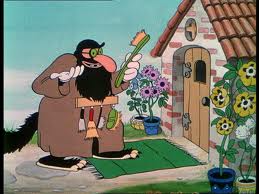
Whether those drawings are real or not—it's an open question—his fondness for Disney is undisputed. According to Goebbels—who gave Hitler various Disney products over the years—on the presentation of mouse ears as a gift, Hitler “clapped his hands in glee, and immediately ran to his room to change into the mouse ears and Donald Duck footy pajamas.” 9  Hitler was known to often whistle “Who’s afraid of the big, bad wolf” (his nickname being Wolf), from the 1932 Disney cartoon Three Little Pigs.10  As he was invading various nations, whistling the tune, was he thinking “I’m going to huff and puff and blow your house down”?  Sure, why not?  Ironically, the original Disney version contained a stereotypical portrayal of the wolf disguised as a Jewish peddler at the last house. I wonder if Hitler actually thought that was funny? Because of complaints from some in the Jewish community, the (clueless) Disney redid the original version and changed the wolf to a “Fuller Brush Man.”


The Jewish Fuller Brush man/ wolf - see here at 6:05
Unsurprisingly, the complaints continued. Bowing to the pressure, he finally dropped—in blatant form—the Jewish schtick in the last version made in the 1940s.11 

I think this version still has vestiges of the stereotype, but it certainly isn't so blatant. See video here

Sorry to go on in some length on this, but I think it is interesting apart from my central topic. I mean, is Disney bad for us? Obviously, I don’t believe that Hitler was driven by Disney to his acts, even if Disney—unlike Wagner—did have clear anti-Semitic stereotypes in his work. I think the whole blame-game is ridiculous, actually. But if you are going to blame some music, I’m going to blame the damn soundtrack of The Three Little Pigs.

Returning to the central discussion, because of Hitler’s enthusiasm for Wagner’s music, many people feel that Wagner’s music must be sort of fascistic or militaristic and, generally, all similar to “The Ride of the Valkyries.” This famous quip—see it here—from Woody Allen captures that sentiment:  “I can't listen to that much Wagner, ya know? I start to get the urge to conquer Poland.”

Of course, it is not the case at all that Wagner's music is generally militaristic, much less fascistic. I think Bryan Magee hits it on the head: “I sometimes think there are two Wagners in the culture, almost unrecognizably different from one another: the Wagner possessed by those who know his work, and the Wagner imagined by those who know him only by name and reputation.”12  “The Ride of the Valkyries,” the tune he is most known for, is rather singular. It was written—Wagner called it “my vaudeville”—to break-up what had come before and what was to soon to come in Die Walküre. Originally, he tried to ban its separate performance, as it was wrenched out of context, but he later relented.  In any case, it is certainly not a very good representation of Wagner’s music on the whole, even if one feels that this piece is in some way fascistic, which I think is a rather absurd claim.  The fact is that only someone ignorant of Wagner’s music and text could seriously make a claim that Wagner’s operas are fascistic when they actually are, in fact, close to the exact opposite, which is particularly true about The Ring, which is a condemnation of the quest for power.

I do think that Wagner’s music is incredibly powerful. His subject matter—setting it primarily in the world of myth—is the human condition. As with any great work of art, there are and can be limitless interpretations through the prism of our individuality. Great art works pretty much like a sort-of Rorschach test; if you see something dark and ugly and twisted, it's all about you and not about the work. Ultimately, I concur with Spice’s conclusion on the question he posed:
In the question ‘Is Wagner bad for us?’ there’s a hint of tiresome passivity, as though we had no choice in the matter. There are substances and there is substance abuse. It’s surely up to us to manage Wagner’s charisma, up to us to maintain the ‘and’ in our relationship with him. But whether it’s really possible to keep Wagner at a distance without losing something essential in our experience of his work is unclear to me.

End Notes

1 Millington, ed, The Wagner Compendium, 253 
2 Spencer, Wagner Remembered, 240 
3 Wagner,  Opera and Drama, 109   
4 Op. cit, Spencer, 240
5 See here.
6 Magee, Aspects of Wagner, read the chapter 3 Wagnerolatry  31-44
7 Tanner, Wagner 22  
8 Here is a link about this. While it cannot be proven that Hitler was the person who drew these, it hasn't been debunked either.  I would tend towards skepticism, but it certainly could be true.
9 For the quote, go here. I can't find a reference to the actual place in the diaries that this quote comes from, so it's a shaky reference—though oft-quoted. However, here is another one that isn't shaky: In Joseph Goebbels' 1937 diary entry for December 22, he writes excitedly of his giving the Fuhrer ‘18 Mickey Mouse films’ for his Christmas present. He also notes that the Fuhrer ‘is very excited about it. He is completely happy about this treasure.’ ”
10 See here
11 For the story of altering of The Three Little Pigs, see here and here
12 Magee, The Tristan Chord, 74